How to Measure Facial Thirds: A Step-by-Step Photo Guide
Use four simple landmarks to compare the upper, middle, and lower thirds of the face without turning facial balance into a rigid beauty score.

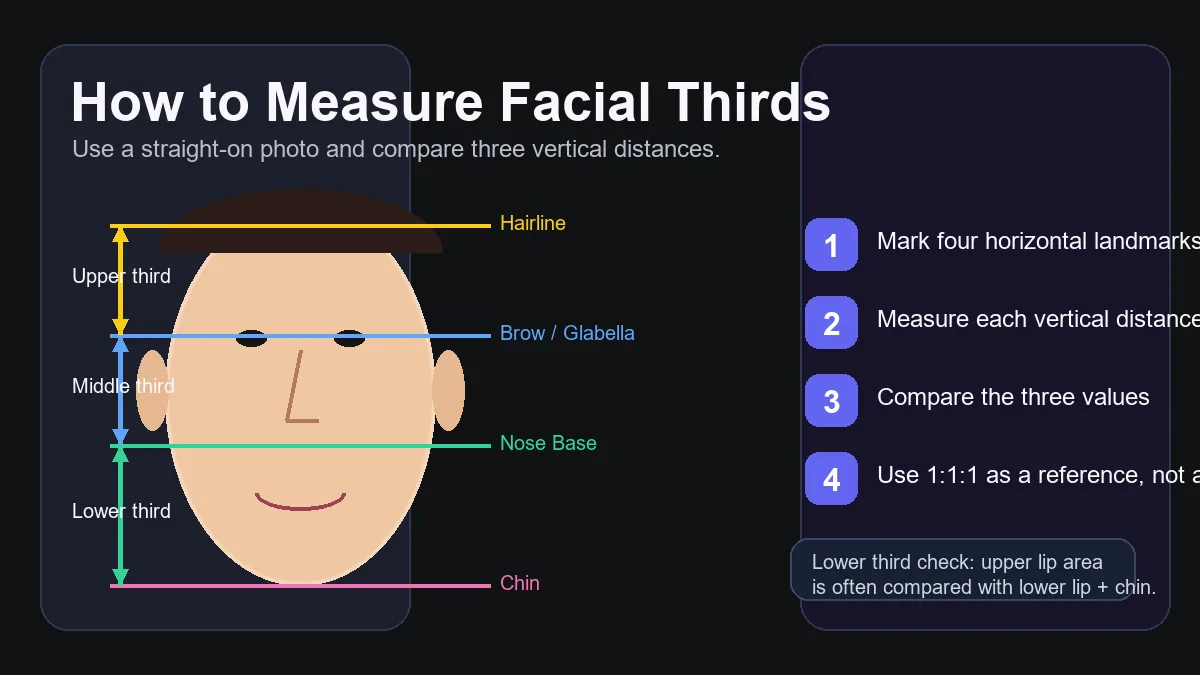
Facial thirds divide the visible face into upper, middle, and lower vertical sections so you can compare balance from a straight-on photo.
Table of Contents
What Are Facial Thirds?
Facial thirds are a simple way to describe vertical face balance. Instead of looking at the whole face as one measurement, you divide the face into three stacked sections: the upper third, the middle third, and the lower third. This framework is common in facial aesthetics, orthodontics, portrait drawing, and photo-based face analysis because it makes proportion easier to see.
The classic reference is 1:1:1, meaning each third is roughly equal in height. That does not mean every face should be mathematically identical. Hairline shape, age, sex, expression, camera angle, and natural ancestry all affect how the thirds appear. The goal is to understand balance, not to force every face into one ideal.
The practical rule
Equal facial thirds are a reference point. A useful facial thirds test tells you which third is visually longer or shorter and whether the difference is large enough to matter in a photo.
The Four Landmarks You Need
The hardest part is not the math. It is choosing consistent landmarks. Use the same points each time you compare photos.
| Landmark | Where to mark it | Why it matters |
|---|---|---|
| Hairline / trichion area | Visible hairline at the top of the forehead | Starts the upper third; hidden hairlines reduce confidence |
| Brow / glabella region | Area between the eyebrows or brow line | Separates the upper third from the middle third |
| Nose base / subnasale | Where the base of the nose meets the upper lip area | Separates the middle third from the lower third |
| Chin / menton | Lowest visible point of the chin | Ends the lower third measurement |
How to Measure Facial Thirds Step by Step
You can do this with a ruler on a printed photo, a phone markup tool, or any image editor that lets you draw horizontal lines. For better consistency, use a straight-on image with the camera at eye level.
- Prepare the photo: Use a front-facing portrait with neutral expression, even lighting, no head tilt, and the hairline and chin visible. Avoid wide-angle selfies taken too close to the face.
- Draw the hairline line: Mark the visible hairline or estimated trichion area. If bangs, hats, or cropping hide this point, the upper third will be less reliable.
- Draw the brow line: Mark the glabella or brow region, usually around the area between the eyebrows. Keep the line level across the face.
- Draw the nose-base line: Mark the subnasale, the point where the base of the nose meets the upper lip area. This separates the middle third from the lower third.
- Draw the chin line: Mark the lowest visible point of the chin, often called the menton in facial measurement contexts.
- Measure and compare: Measure the vertical distance between each pair of lines. Convert the three numbers into a ratio by dividing each value by the smallest one, or simply compare the percentages of total measured face height.
Photo setup matters
If the head is tilted up, the lower third can look shorter. If the camera is above the face, the upper third can look larger. A level photo is more important than using a perfect ruler.
How to Interpret Your Facial Thirds Ratio
A facial thirds ratio is easiest to read when you label the pattern instead of chasing a perfect number. A small difference is normal; a large difference is more likely to affect perceived vertical balance.
| Pattern | What it suggests | How to read it |
|---|---|---|
| Upper, middle, and lower thirds are close | Relatively balanced vertical proportions | Use 1:1:1 as a rough description, not a claim of perfection |
| Upper third appears longer | Forehead or visible hairline area may dominate | Check whether hairline visibility, hairstyle, or camera angle inflated the measurement |
| Middle third appears longer | The brow-to-nose-base section may visually stretch the midface | Compare several neutral photos before drawing conclusions |
| Lower third appears longer | The nose-base-to-chin section may dominate vertical balance | Review the upper lip, lower lip, and chin split for more context |
| One third appears much shorter | The face may look vertically compressed in that area | Rule out head tilt, cropped images, and expression changes first |
A result like 1:1.05:1.12 is usually close enough to be described as balanced in casual photo analysis. A result like 1:1.25:1.55 suggests the lower third is visibly longer, especially if the same pattern appears across several photos.
Common Mistakes When Measuring Facial Thirds
Most bad facial thirds measurements come from inconsistent photos or landmarks, not from the formula itself.
- Using the top of the head instead of the hairline: Facial thirds start near the hairline, not at the highest point of the skull or hairstyle.
- Measuring from a smiling photo: A smile can raise the cheeks, change lip position, and make the lower third look different.
- Ignoring the lower-third split: After measuring the lower third, many analysts also compare upper lip height with lower lip plus chin. This adds context when the lower face looks long or short.
- Comparing photos taken at different angles: A small camera angle change can shift the apparent brow, nose base, and chin distances enough to change the result.
- Treating equal thirds as a beauty diagnosis: Facial thirds describe proportion. They do not diagnose health, guarantee attractiveness, or replace a professional evaluation.
Manual Measurement vs an AI Facial Thirds Calculator
Manual measurement is useful because it teaches you where the landmarks are. It also lets you see why a photo might produce an unreliable result. The downside is that small errors in line placement can change the ratio, especially when the image is low resolution or the hairline is hard to see.
An AI facial thirds calculator can make the process faster by detecting landmarks and estimating the upper, middle, and lower sections automatically. It is still photo-dependent, so the best approach is to use a clear image, review the confidence notes, and treat the result as an educational estimate rather than a final judgment.
Facial Thirds Measurement FAQ
References and Further Reading
- Facial thirds and vertical facial analysis are commonly used in orthodontics, dentistry, facial aesthetics, and portrait drawing as descriptive proportion frameworks.
- National Library of Medicine overview of facial attractiveness research and the limits of single-ratio beauty claims. NCBI / PubMed Central
- Golden Ratio Face Calculator guide to facial thirds, golden ratio measurements, and AI photo-based face analysis. Golden ratio face science
Last updated: May 23, 2026