Face Proportions Guide: How Facial Ratios Really Work
A practical guide to facial thirds, golden ratio cues, symmetry, midface balance, and the limits of using one number to judge a face.

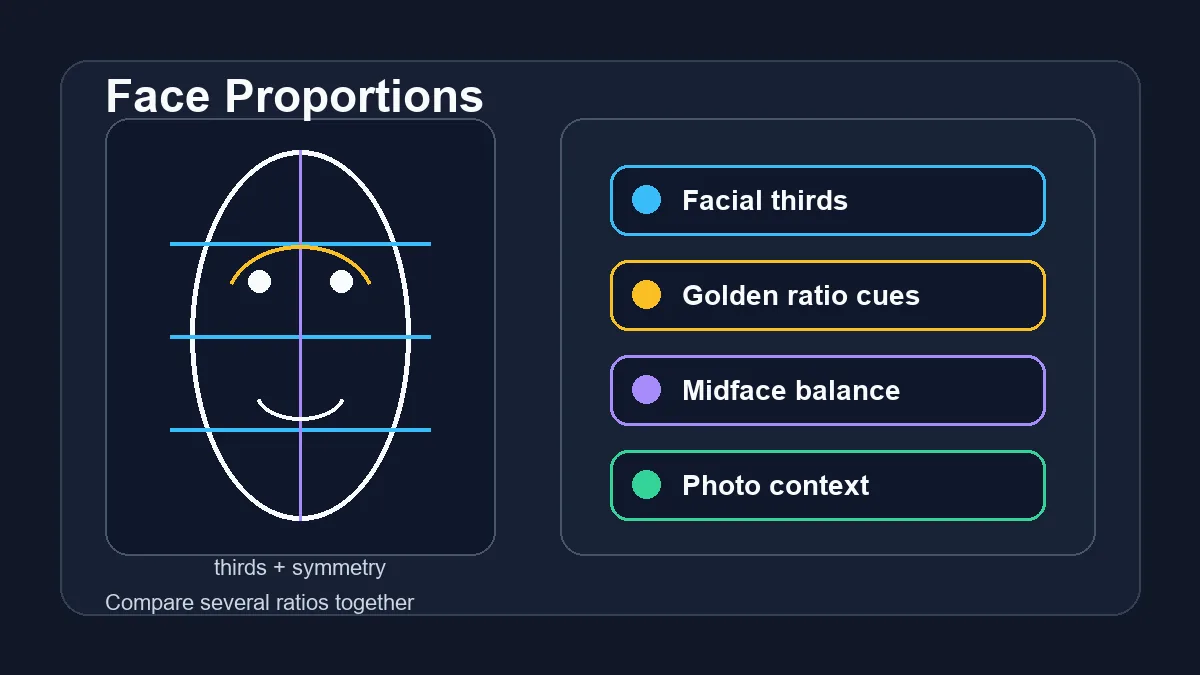
Face proportions are easiest to read when several measurements are considered together instead of turning one ratio into a verdict.
Table of Contents
What Are Face Proportions?
Face proportions are measurements that compare one facial distance with another. Common examples include face length compared with face width, the three vertical facial thirds, the balance between the upper and lower midface, and the spacing between paired features such as the eyes and mouth corners.
People often search for ideal face proportions because they want a clear answer. In practice, proportions are more useful as a map than as a score. They help you notice whether a photo reads as vertically balanced, wide, narrow, long in the midface, lower-face dominant, or slightly asymmetric.
The useful way to think about it
A face proportion result is a structured description of balance. It is not a medical diagnosis, a universal beauty rule, or proof that one face is objectively better than another.
The Main Facial Ratio Systems
Most online face ratio calculators combine several older analysis frameworks. Understanding the difference between them helps you interpret the result without mixing up separate ideas.
| System | What it compares | What it can help explain |
|---|---|---|
| Facial thirds | Upper, middle, and lower vertical face sections | Whether the face reads as vertically balanced or dominated by one third |
| Golden ratio cues | Length, width, feature spacing, and phi-like relationships | How closely several facial distances align with classic harmony references |
| Face symmetry | Left-right balance of eyes, mouth, nose, chin, and jaw | Whether asymmetry is visible or mostly a camera/pose issue |
| Midface ratio | Central face length around the eye line, nose base, philtrum, and lower face | Whether the midface appears compact, balanced, or visually long |
The strongest reading comes from overlap. If facial thirds, symmetry, and midface balance all point in the same direction across several neutral photos, the pattern is more meaningful than a single number from one image.
How to Read a Face Proportion Result
When you use a face ratio calculator, start with the pattern instead of the score. A useful result should tell you which measurements are close to balanced, which areas stand out, and whether the photo conditions may have distorted the result.
- Check whether the landmarks make visual sense before reading the score.
- Look for repeated patterns across facial thirds, midface balance, symmetry, and golden ratio cues.
- Treat small differences as normal variation, especially when the photo is angled or cropped.
- Compare two or three neutral front-facing photos before drawing a conclusion.
- Use the result to understand balance, then decide whether a more specific tool such as facial thirds or midface ratio is a better next step.
Photo Quality Issues That Change Face Ratios
A surprising number of proportion problems come from the photo, not the face. Before comparing ratios, rule out the most common distortions.
- Camera height: A high camera can enlarge the upper face, while a low camera can make the lower face look longer.
- Lens distance: A close selfie lens can exaggerate central features and change perceived facial width.
- Head tilt: Even a small tilt changes eye level, chin position, and symmetry measurements.
- Expression: Smiling, tightening the mouth, or raising the brows changes lower-face and eye-area proportions.
- Hairline visibility: Bangs, hats, and cropped foreheads make the upper third harder to measure accurately.
Which Face Proportion Tool Should You Use?
Use the broad golden ratio calculator when you want an overall overview, then move to a focused tool when one part of the result needs a closer look.
| Goal | Best starting page | Why |
|---|---|---|
| Overall face proportion overview | Golden Ratio Face Calculator | It combines multiple measurements and gives a broad first read. |
| Vertical balance only | Facial Thirds Calculator | It focuses on upper, middle, and lower facial sections. |
| Left-right balance | Face Symmetry Test | It checks visible asymmetry and alignment cues. |
| Central face length | Midface Ratio Calculator | It looks more closely at midface and lower-face context. |
| Mixed proportion concerns | Facial Harmony Calculator | It reviews several proportion signals together in a broader harmony score. |
The Limits of Ideal Face Proportions
Ideal face proportions are useful because they create a shared language for describing structure. They become misleading when they are treated as one universal template. Real faces vary by age, sex, ancestry, expression, hairstyle, camera setup, and personal preference.
A face can be expressive, memorable, and attractive without matching every classic ratio. A balanced interpretation should combine measurements with visual context and should avoid turning normal variation into a flaw.
Use ratios as context
The best question is not whether your face is mathematically perfect. The better question is which proportions are stable across good photos and what they explain about the way your face reads.
Face Proportions FAQ
References and Further Reading
- Research reviews on facial attractiveness discuss proportion, symmetry, averageness, and the limits of reducing beauty to one ratio. NCBI / PubMed Central
- For a focused vertical-balance explanation, read the guide to equal facial thirds. Equal Facial Thirds
- For a landmark-by-landmark measurement walkthrough, read the photo guide to measuring facial thirds. How to Measure Facial Thirds
Last updated: June 11, 2026