Equal Facial Thirds Explained: What a Balanced Face Ratio Really Means
A practical guide to the 1:1:1 facial thirds ratio, what it can tell you about vertical facial balance, and what it definitely cannot.

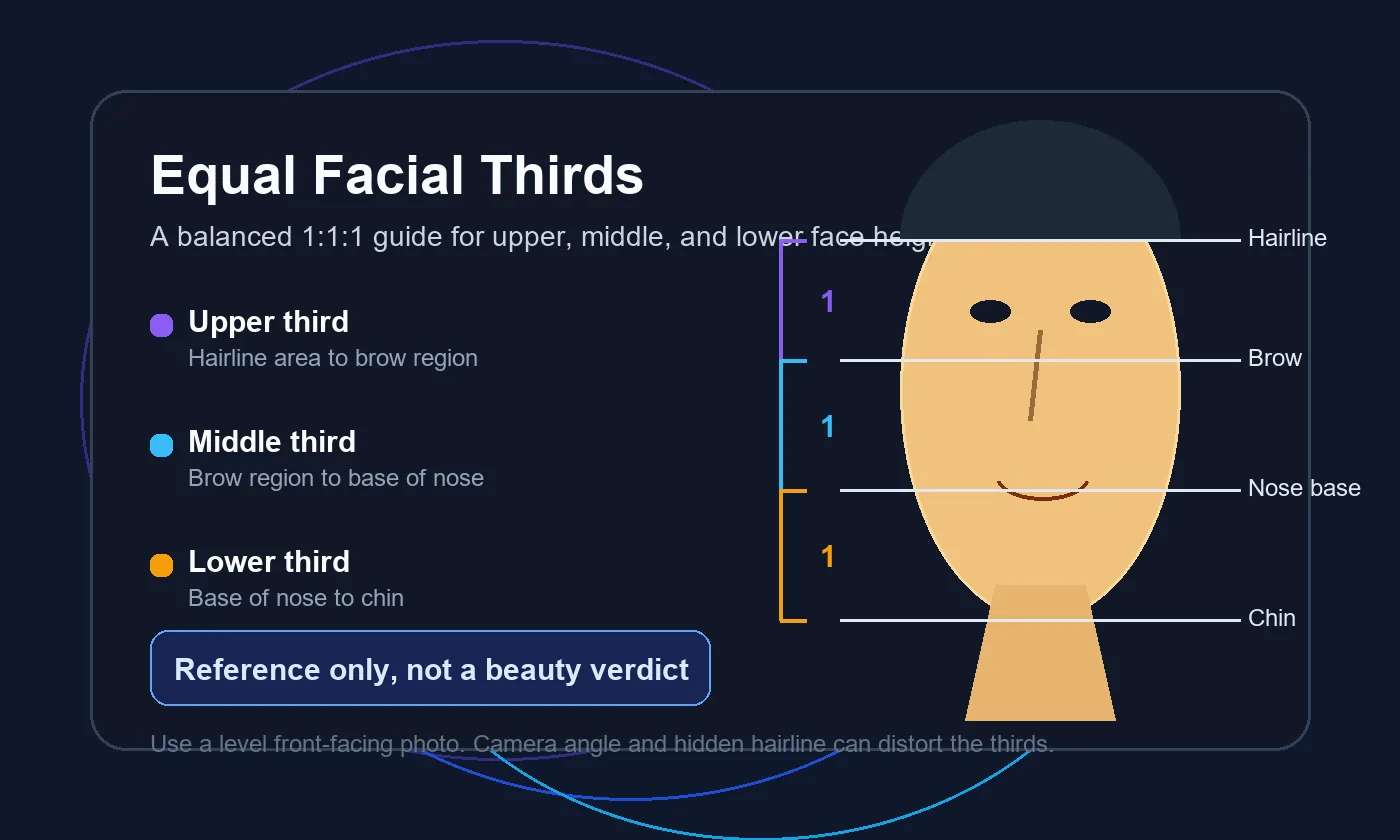
Equal facial thirds describe a face where the upper, middle, and lower vertical sections are close in height when measured from a straight-on photo.
Table of Contents
What Do Equal Facial Thirds Mean?
Equal facial thirds describe a face where three vertical sections are close in height: the upper third from the hairline area to the brow region, the middle third from the brow region to the base of the nose, and the lower third from the nose base to the chin. In classical facial proportion language, this is usually summarized as a 1:1:1 facial thirds ratio.
That ratio is a reference point, not a biological law. Real faces vary by ancestry, sex, age, hairline shape, and soft tissue structure. A face can look balanced without measuring as a mathematically perfect set of equal thirds, and a face can measure close to equal thirds without matching every beauty preference.
The key idea
Equal facial thirds are best treated as a way to describe vertical balance. They are not proof of beauty, health, or surgical need.
Why Analysts Look at Facial Thirds
Facial thirds help simplify a complex face into a vertical structure people can compare consistently. Orthodontists, facial aesthetics specialists, portrait artists, and photo-analysis tools often use the thirds because they show whether the forehead zone, midface, or lower face visually dominates the overall shape.
This is especially useful when someone wants to understand why one photo feels balanced and another does not. A facial thirds ratio can explain whether the issue comes from a long lower face, a compressed midface, a hidden hairline, or just a misleading camera angle.
| Question | What facial thirds can help with | What it cannot prove |
|---|---|---|
| Why does one photo look more balanced? | It can show whether the upper, middle, or lower third visually dominates. | It cannot prove the face itself changed; the photo setup may be different. |
| Is the lower face long or short? | It can flag whether the lower third looks proportionally longer or shorter. | It cannot diagnose a clinical or skeletal issue on its own. |
| Does equal thirds mean attractive? | It can describe one kind of proportion often seen as balanced. | It cannot define attractiveness for every person or culture. |
| Should I compare multiple photos? | Yes, repeated patterns are more reliable than one image. | One photo alone should not be treated as definitive. |
What Can Change How Equal Facial Thirds Look
Before you treat any facial thirds ratio as meaningful, you need to know what changes the result. Many apparent imbalances come from the photo rather than the face itself.
- Hairline visibility: If bangs, hats, or cropping hide the top landmark, the upper third becomes an estimate rather than a clean measurement.
- Camera angle: A camera placed above the face can exaggerate the upper third, while a low angle can make the lower third look longer.
- Expression: Smiling or tightening the lips can change the visible lower third and alter how the chin and mouth area read in the photo.
- Head posture: Even slight head tilt can distort the brow, nose base, and chin distances enough to change the facial thirds ratio.
- Age and anatomy: Soft tissue, jaw shape, dental structure, and age-related change can all affect how equal or unequal the thirds appear.
How to Check Your Own Facial Thirds
The most reliable way to check equal facial thirds from a photo is to use a straight-on image and keep the process consistent across comparisons.
- Use a front-facing photo with neutral expression, even lighting, and the full forehead and chin visible.
- Mark the visible hairline or estimated trichion area, the brow or glabella region, the base of the nose, and the bottom of the chin.
- Measure the three vertical distances and compare them as upper, middle, and lower thirds.
- Label the result as balanced, upper-third dominant, midface dominant, or lower-third dominant instead of chasing a false perfect score.
- If you want a faster estimate, use a facial thirds calculator and then review whether the landmarks look correctly placed.
Common Facial Thirds Patterns
Most people do not fit a perfectly equal 1:1:1 facial thirds ratio, and that is normal. What matters more is recognizing the pattern clearly.
| Pattern | What it usually means | Useful next step |
|---|---|---|
| Upper, middle, and lower thirds are close | The face reads as relatively balanced vertically. | Check whether the lower-third split also looks proportionate. |
| Upper third appears longer | The forehead or visible hairline area may dominate the vertical reading. | Verify that hairline visibility and camera height did not inflate the result. |
| Middle third appears longer | The brow-to-nose-base area may stretch the visual midface. | Compare several neutral photos before drawing conclusions. |
| Lower third appears longer | The nose-base-to-chin section may dominate the vertical balance. | Review the lower-third 1:2 split and check head angle. |
| One third appears much shorter | That area may read as vertically compressed. | Rule out cropped images, tilt, and expression changes first. |
When the same pattern appears across multiple level, front-facing photos, it is more likely to reflect your actual vertical proportions rather than a one-off camera artifact.
The Limits of the Equal-Thirds Idea
Equal facial thirds are useful because they give you a shared language for vertical facial proportion. But they become misleading when people use them as a rigid beauty score or as proof that one face is objectively better than another. Faces are not architecture drawings, and small differences are not flaws.
A good analysis uses equal facial thirds alongside other context: symmetry, feature shape, lower-third split, photo quality, and the fact that human attractiveness is influenced by much more than one proportional framework.
Use it as context, not verdict
If a facial thirds ratio helps you understand balance, it is useful. If it makes you think every face must fit one ideal template, it is being used badly.
Equal Facial Thirds FAQ
References and Further Reading
- Facial thirds and lower-third proportion are widely used as descriptive frameworks in orthodontics, facial aesthetics, and portrait analysis.
- Research reviews on facial attractiveness emphasize that proportional balance matters, but no single ratio fully explains human beauty. NCBI / PubMed Central
- For a landmark-by-landmark walkthrough, read the step-by-step guide to measuring facial thirds from a photo. How to measure facial thirds
Last updated: June 5, 2026