ChatGPT Face Rating: Prompts, Accuracy, Privacy, and Better Limits
A practical guide to ChatGPT face rating prompts, honest accuracy limits, photo quality, and privacy without treating one score as a final judgment.

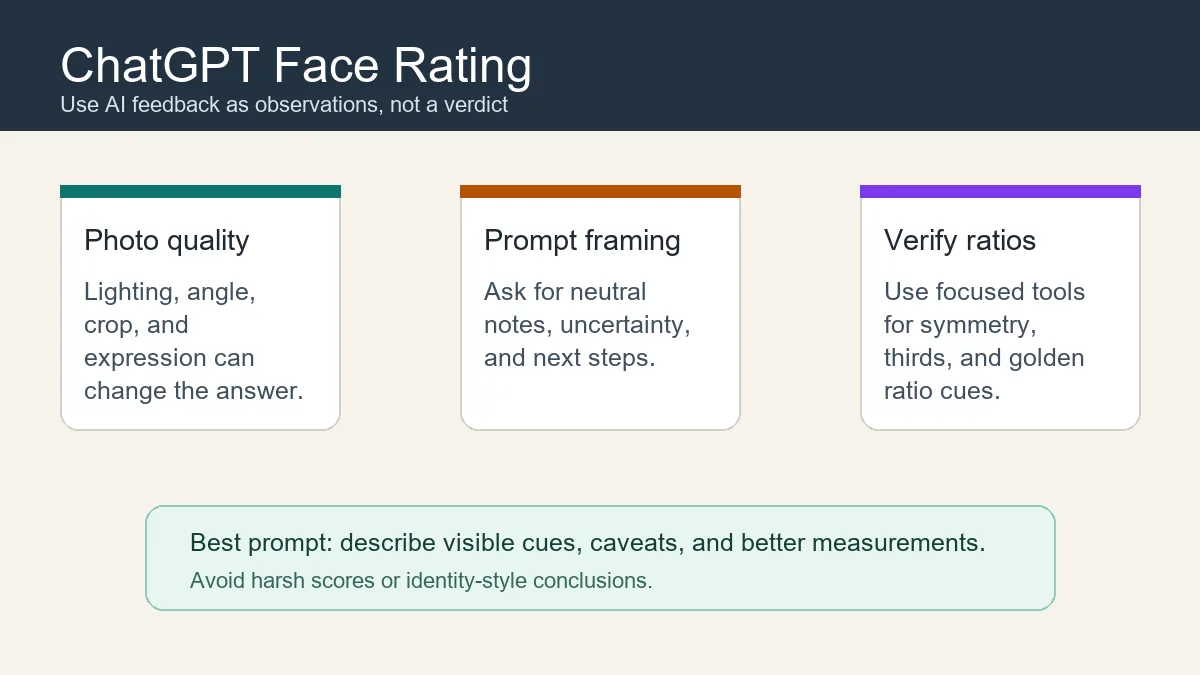
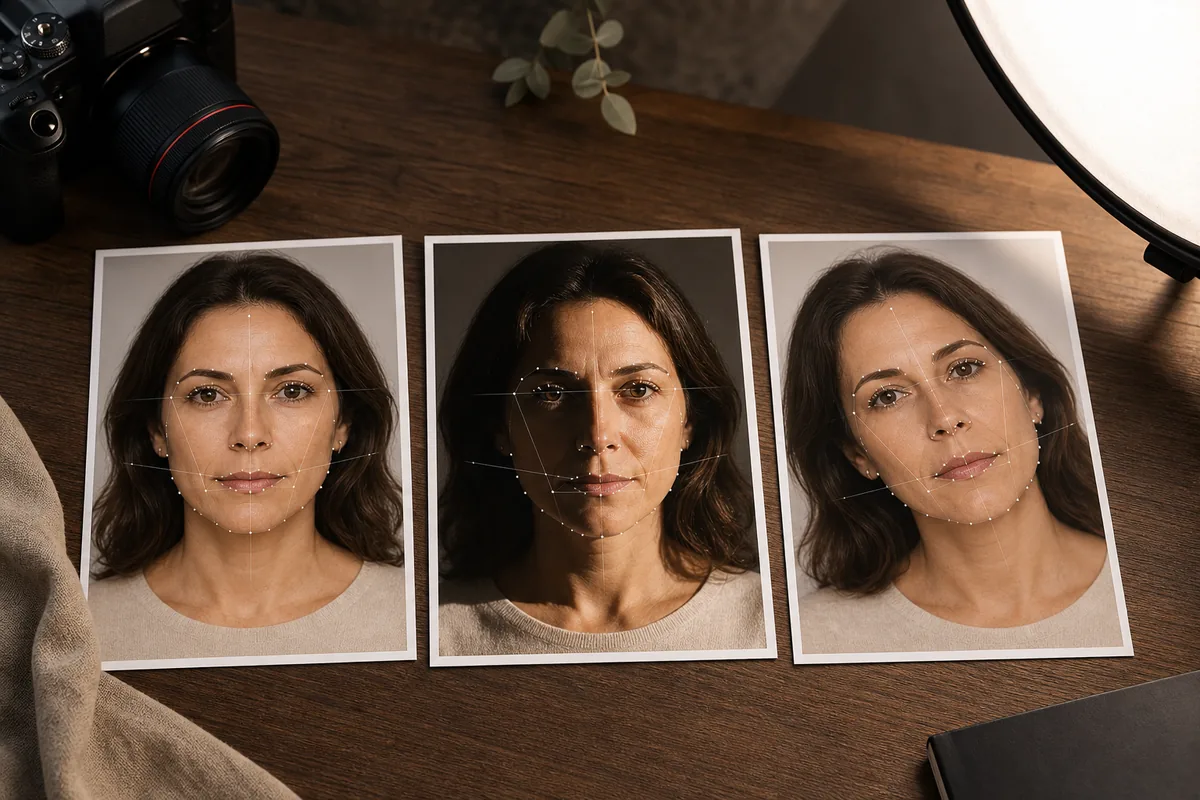
A useful ChatGPT face rating prompt asks for observable proportion notes, uncertainty, and photo-quality caveats instead of a blunt score.
Table of Contents
What Is a ChatGPT Face Rater?
A ChatGPT face rater is not usually a separate product. It is a way people use a vision-capable AI chat model: they upload a face photo, ask the model to rate attractiveness, and expect a score or explanation. The appeal is obvious because it feels conversational, fast, and more flexible than a fixed calculator.
A general chat model can notice visible cues, but it does not expose a fixed facial-ratio formula or guarantee a consistent score. The phrase ChatGPT face rating often covers several different tasks: a casual description, a prompt for face analysis, or a request for an attractiveness number. Those intents should be separated so a conversational answer is not mistaken for a measurement.
Best use case
Use ChatGPT for a plain-language explanation of what a photo appears to show. Use a dedicated calculator when you want repeatable proportion measurements such as facial thirds, symmetry, or golden ratio cues.
How ChatGPT Face Rating Usually Works
A typical ChatGPT face rating workflow has four parts. Understanding them helps you control the output and avoid taking an overconfident answer too seriously.
- Photo upload: The model receives a visible image, so angle, resolution, lighting, crop, expression, and obstructions strongly affect the answer.
- Visual description: The model identifies observable cues such as face orientation, symmetry, contrast, skin texture, hairstyle, and broad proportion balance.
- Prompt framing: If you ask for a harsh numerical rating, the answer may become less useful. If you ask for neutral observations, uncertainty, and photo-quality notes, the output is usually safer and clearer.
- Human interpretation: The most important step is how you read the result. A useful response should describe cues and limitations, not define your worth or attractiveness.
This is why two prompts about the same image can produce different responses. The model is generating an explanation, not running a transparent, fixed facial-ratio formula.
How Accurate Is ChatGPT Face Rating?
ChatGPT can help with a broad, plain-language read of a photo. It may notice that the camera is too close, the head is tilted, or one side is darker. That makes it useful for checking whether a photo is suitable for analysis and for organizing observations.
It is much less reliable as a score or as an honest universal ranking. Lighting, lens distance, expression, grooming, prompt wording, cultural assumptions, and model limits can change the response. Treat an answer as a conditional description, not a calibrated face rating.
| Factor | Why it changes the rating | Better way to read it |
|---|---|---|
| Lighting | Shadows can make symmetry, skin texture, and feature contrast look different. | Use even front light and compare more than one photo. |
| Angle | A tilted or close selfie changes face width, nose size, and jaw balance. | Use a straight, eye-level photo before reading proportion comments. |
| Prompt wording | A harsh prompt asks for a score; a better prompt asks for observations and uncertainty. | Ask for neutral proportion notes instead of a verdict. |
| Model limits | A general chatbot may describe visible cues but is not a calibrated beauty measurement tool. | Use it as a second opinion, then verify with a dedicated calculator. |
A Safer ChatGPT Face Rating Prompt
If you still want to use ChatGPT for face feedback, avoid asking for a blunt attractiveness score. Ask for observable, photo-based notes with uncertainty instead.
ChatGPT face analysis prompt example
Please analyze this photo neutrally. Describe photo quality, lighting, camera distance, head position, expression, visible symmetry cues, facial thirds, and broad proportion balance. Separate observations from uncertainty, do not give a harsh attractiveness score, and say which points should be checked with a dedicated calculator.
- Ask for observations: This keeps the response focused on visible, checkable details instead of a personal verdict.
- Ask for uncertainty: A good response should say when angle, crop, or lighting makes a conclusion weak.
- Ask for next steps: The best output tells you whether to retake the photo, check symmetry, measure facial thirds, or compare several images.
- Name the analysis limits: Ask the model to separate visible observations from guesses and to say when a dedicated measurement tool would be more reliable.
Privacy Questions Before Uploading a Face Photo
A face photo is personal data. Before using a ChatGPT face rating prompt or any AI face analysis service, review the product's data controls, retention settings, and privacy policy. The exact options depend on the service and account type.
Upload only the minimum image needed, remove other people and identifying details, and avoid IDs, private locations, medical context, or images of minors. If you only need a proportion estimate, a focused calculator with clear measurement limits may be easier to evaluate.
- Use a cropped front-facing photo that excludes other people and identifying background details.
- Do not upload minors, private documents, medical images, or photos you would not be comfortable sharing with an online service.
- Prefer tools with clear deletion, retention, and data-use explanations.
- If you only need a proportion estimate, use a calculator that explains what it measures instead of asking for a personal attractiveness verdict.
Better Alternatives to a ChatGPT Face Rater
Choose the tool according to the question. A ChatGPT face rating prompt is useful for conversational photo feedback, while a focused calculator is easier to repeat when you want symmetry, facial thirds, midface ratio, or broader proportion context.
| Goal | Better option | Reason |
|---|---|---|
| Overall face proportion overview | Golden Ratio Face Calculator | It is built for photo-based facial ratio analysis and gives structured proportion context. |
| Left-right balance | Face Symmetry Test | It focuses on alignment, tilt, and asymmetry instead of a broad attractiveness score. |
| Facial thirds | Facial Thirds Calculator | It checks upper, middle, and lower face balance more directly. |
| Central face length | Midface Ratio Calculator | It gives a clearer read on midface balance than a general chat response. |
| Mixed harmony questions | Facial Harmony Calculator | It combines several proportion signals while keeping the result easier to interpret. |
How to Interpret Any AI Face Rating Result
Whether the feedback comes from ChatGPT, a face rater, or a golden ratio calculator, read it as a structured observation rather than a final answer. One photo is too fragile to define facial balance.
- Check whether the photo is front-facing, evenly lit, and not distorted by a close lens.
- Look for repeated patterns across two or three neutral photos instead of trusting one result.
- Separate photo-quality notes from actual facial proportion notes.
- Treat small differences as normal variation rather than flaws.
- Use focused tools for specific questions: symmetry, facial thirds, midface ratio, or overall harmony.
The healthiest use of AI face feedback is curiosity and education. It can explain why a photo reads differently from another, but it cannot measure personal worth or guarantee how attractive someone appears in real life.
ChatGPT Face Rating FAQ
References and Further Reading
- OpenAI documents ChatGPT Data Controls, including the model-improvement setting and Temporary Chat behavior. OpenAI Data Controls FAQ
- OpenAI explains how content from individual services may be used to improve model performance and how opt-out controls work. OpenAI data use
- Research reviews on facial attractiveness discuss proportion, symmetry, averageness, and the limits of reducing beauty to one score. NCBI / PubMed Central
Last updated: August 13, 2026