What Is Facial Harmony? Meaning, Features, and How to Assess It
A practical, non-judgmental guide to how facial features work together—and why harmony is broader than symmetry or a single ratio.

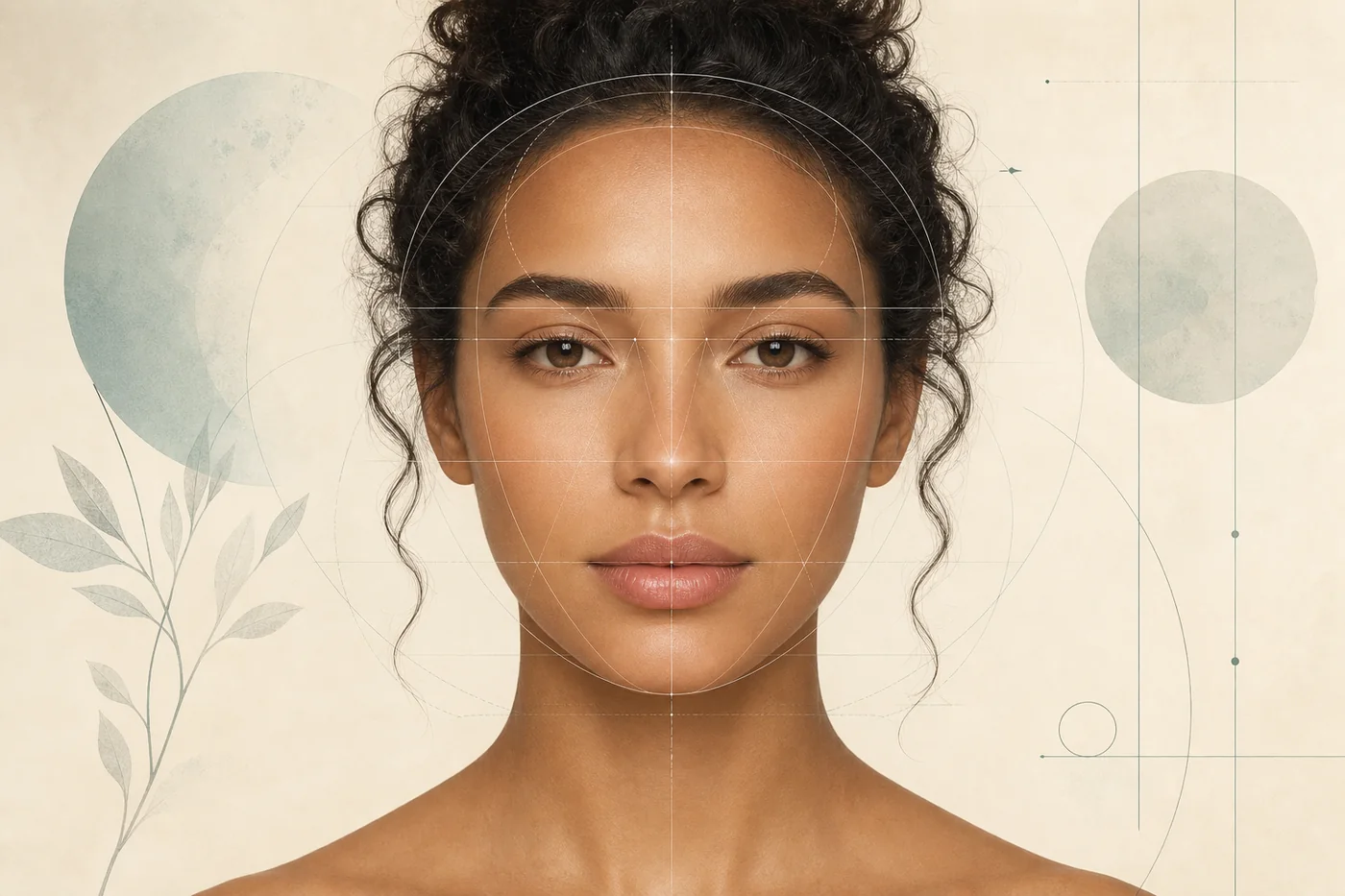
Facial harmony combines several relationships rather than one perfect number.
What Does Facial Harmony Mean?
Facial harmony is the overall visual balance created when facial features feel proportionate to one another. Instead of asking whether one nose, eye shape, lip, or jaw is ideal in isolation, harmony asks whether those features belong together within the same face.
This is why two people can have very different features and both look balanced. Size, spacing, projection, contour, and transitions between areas matter more than matching one universal template. Harmony is also contextual: expression, age, styling, and photographic perspective affect the final impression.
The useful definition
Harmony is a relationship among features, not a universal beauty rank.
Which Features Shape Facial Harmony?
Most assessments combine several measurements and visual relationships. Each one describes a different part of the face, and none should be treated as a complete verdict.
| Component | What it considers | Why it matters |
|---|---|---|
| Facial thirds | Hairline to brows, brows to nose base, nose base to chin | Shows vertical balance |
| Eye spacing | Distance between and around the eyes | Affects central facial rhythm |
| Midface | Eye area to upper lip and surrounding projection | Changes perceived compactness or length |
| Jaw and chin | Width, taper, projection, and lower-face height | Frames the lower face |
| Feature scale | Relative size of eyes, nose, lips, and face shape | Determines whether features feel cohesive |
| Symmetry | Left-right landmark differences | Adds balance but does not define harmony alone |
A face should be read as a system. A strong score in one row cannot compensate for an unsuitable photo or define the whole person.
Facial Harmony vs Facial Symmetry
Symmetry compares the left and right sides. Harmony is broader: it considers how all features fit together, including vertical and horizontal proportions, profile projection, contours, and visual emphasis.
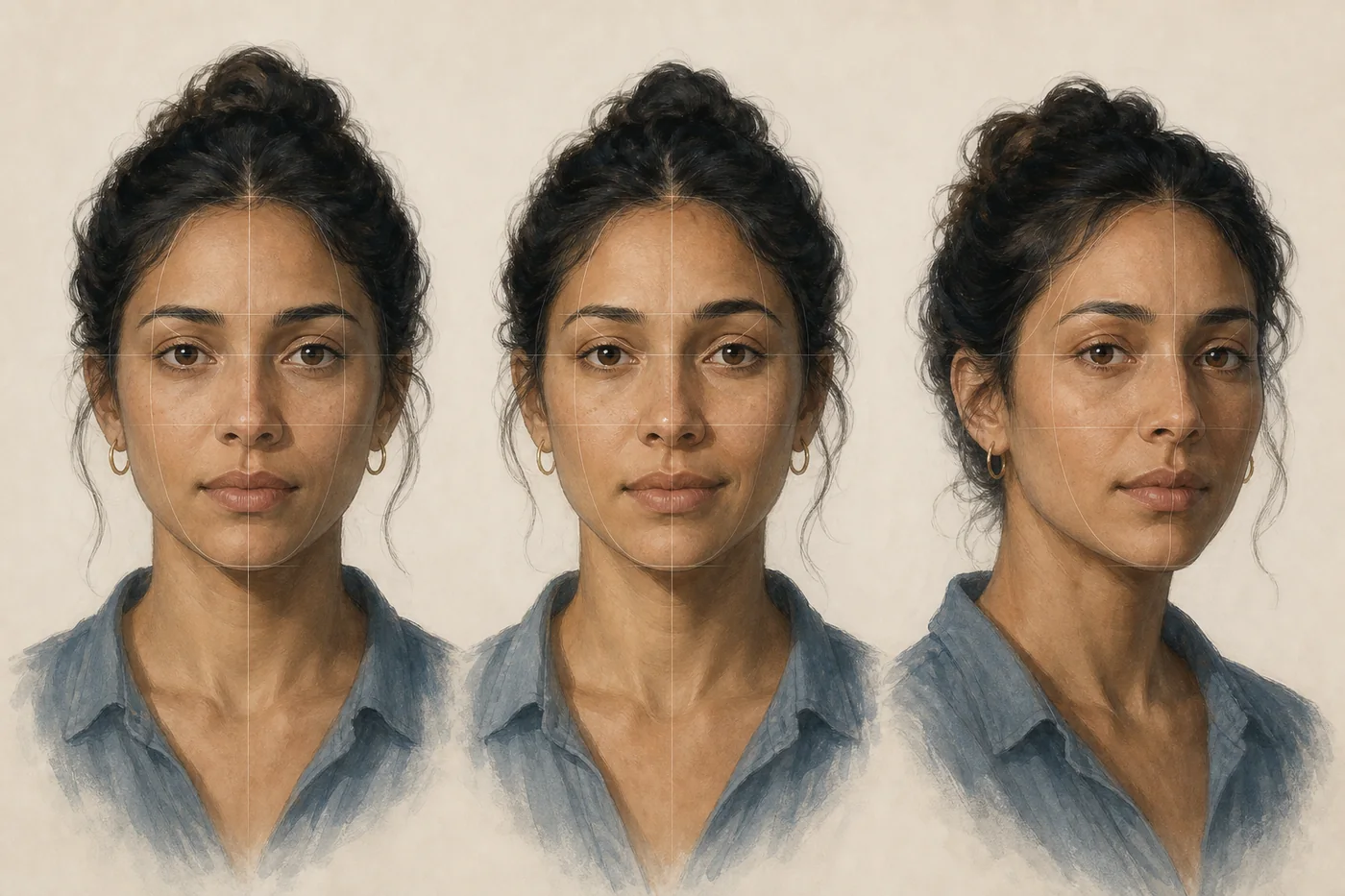
Minor asymmetry is normal. A face may be recognizably asymmetric yet harmonious, while a nearly mirrored face can still look unbalanced if feature size, spacing, or projection conflicts. This is why a symmetry test and a harmony assessment answer related but different questions.
How to Assess Facial Harmony More Carefully
Use a neutral, front-facing photo as a starting point, then consider profile and natural-expression photos for context.
- Use soft, even light and keep the camera near eye level.
- Stand far enough away to reduce wide-angle distortion.
- Check facial thirds, eye spacing, midface proportion, width-to-height ratio, and left-right balance separately.
- Compare measurements with the overall impression rather than forcing every value toward a single target.
- Repeat with another suitable photo before drawing conclusions.
An online facial harmony calculator can organize observations, but its result should be treated as educational feedback rather than an objective attractiveness grade.
Common Facial Harmony Assessment Mistakes
- Using a close selfie: A wide-angle phone lens can enlarge the nose and compress the sides of the face.
- Treating symmetry as harmony: Left-right similarity is only one part of a much larger set of relationships.
- Chasing 100 percent: Human faces are variable; a perfect score is usually a product claim, not a biological standard.
- Ignoring expression: Smiling, squinting, jaw tension, and raised brows change landmarks.
- Judging one feature alone: A feature can look prominent in isolation and still fit the face well.
Can Facial Harmony Be Improved?
Perceived harmony can change through photography, grooming, hairstyle, facial hair, makeup, eyewear, posture, expression, and dental or medical care when appropriate. These choices alter framing and emphasis more readily than underlying bone structure.
Cosmetic or surgical decisions carry trade-offs and should never be based on a web score alone. Anyone considering treatment should discuss goals, limitations, risks, and realistic outcomes with a qualified professional.
A safer goal
Use proportion tools to understand visual relationships, not to search for a flawless face.
Frequently Asked Questions
References
Last updated: July 10, 2026