Facial Harmony vs Golden Ratio: What's the Difference?
A practical comparison of one proportion framework and the broader relationships that shape how a face is read as balanced.


The Short Answer: A Ratio Is Not the Whole Face
The phrase facial harmony vs golden ratio compares a broad visual idea with a narrower measurement framework. Facial harmony asks whether features feel coherent together. The golden ratio asks whether a selected pair of lengths or spaces approaches a mathematical relationship, often written as 1.618 or Phi. The second question can inform the first, but it cannot replace it.
This distinction matters because online discussions often turn a useful proportion into a promise of perfect beauty. Real faces contain variation in age, ancestry, sex, expression, soft tissue, dental support, and profile shape. Camera distance and lens choice can also change the measurements. A responsible comparison therefore treats ratios as descriptive clues and harmony as a contextual reading, not as a pass-or-fail grade.
The useful boundary
Use the golden ratio to explore one relationship. Use facial harmony to understand how several relationships interact.
What Does the Golden Ratio Measure in a Face?
The golden ratio is a mathematical relationship in which the larger part relates to the smaller part in the same way that the whole relates to the larger part. In facial analysis, people may compare face length with face width, selected feature widths, or distances between landmarks. These comparisons are often presented as an aesthetic reference because the number has a long history in art, design, architecture, and popular beauty writing.
A photo calculator may therefore measure several landmark pairs and report how closely each pair sits to its chosen target. That can be interesting and educational, especially when the tool explains which landmarks were used. It becomes misleading when a single target is treated as a biological rule, when the photo is distorted, or when a score is presented as if it measures a person's worth.
- Choose a clearly defined measurement, such as face length divided by face width, rather than saying that the whole face is simply golden.
- Mark repeatable landmarks, because a small change in the hairline, chin, cheek width, or camera crop can change the result.
- Keep the photo setup consistent: level camera, relaxed expression, even light, and enough distance to reduce wide-angle distortion.
- Read several ratios together and compare them with the stated method instead of borrowing a cutoff from a different calculator.
The golden ratio can create a tidy way to describe selected proportions. It does not tell you how a face looks in motion, how features transition into one another, or how a viewer will respond to expression and context.
What Does Facial Harmony Include?
Facial harmony describes the overall fit among features. It can include vertical thirds from the hairline to the brows, brows to the nose base, and nose base to the chin; horizontal spacing around the eyes; the relationship between the midface and lower face; the scale of the nose and lips; jaw and chin shape; profile projection; and left-right balance. The goal is not to make every measurement identical, but to understand whether the relationships feel coherent.
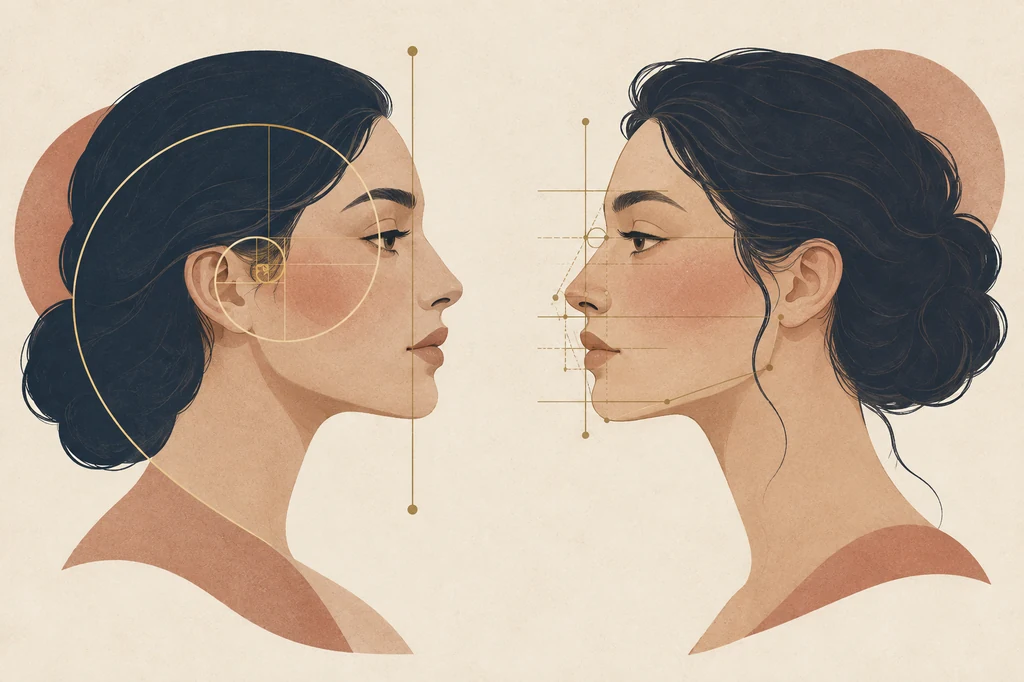
Harmony is also affected by visual emphasis. A strong brow, a prominent nose, a fuller lip, or a tapered jaw can be distinctive without being out of place. Hair, facial hair, glasses, makeup, posture, and expression change the frame around the same underlying structure. That is why a harmony assessment should describe conditions and relationships rather than announce a universal rank.
- Vertical balance: Facial thirds show whether the upper, middle, and lower zones have a similar visual rhythm in a standardized front-facing photo.
- Feature spacing: Eye distance, nose position, mouth width, and the space between features affect how the center of the face reads.
- Scale and transitions: The relative size of each feature and the way one contour flows into another can matter more than a standalone measurement.
- Profile and projection: The nose, lips, chin, forehead, and jaw create depth relationships that a flat front-facing ratio cannot capture.
- Symmetry and expression: Left-right differences and movement are part of the context, but normal asymmetry does not automatically mean poor harmony.
In other words, facial harmony is a system-level interpretation. It can use ratios, but it is not reducible to one ratio.
Golden Ratio vs Facial Harmony: A Side-by-Side Comparison
The clearest way to separate the concepts is to compare the question each method asks, the evidence it needs, and the conclusion it can reasonably support.
| Dimension | Golden ratio | Facial harmony |
|---|---|---|
| Main question | Does a selected relationship approach a mathematical target? | Do several features work together coherently? |
| Typical input | Two or more landmark distances | Multiple proportions, spacing, scale, contours, and context |
| Best use | Describing a specific proportion or teaching a measurement method | Organizing a whole-face proportion discussion |
| Main limitation | It depends on landmark choices and cannot describe every visual relationship | It is broader and more interpretive, so the method must be explained clearly |
| What it is not | A universal beauty score or biological requirement | A diagnosis, objective attractiveness rank, or demand for symmetry |
| How to report it | Name the formula, landmarks, photo conditions, and target | Describe the individual relationships and the limits of the photo |
The two approaches can work together. A golden-ratio measurement can be one row in a broader facial proportion report, while harmony explains how that row relates to the other rows.
How to Assess Facial Harmony and the Golden Ratio Carefully
If you want to compare your own photo, start by improving the input before interpreting the output. A consistent photo is more useful than a highly edited photo with a seemingly precise number.
- Use a neutral, front-facing photo with the head level, eyes open naturally, and the camera close to eye height.
- Stand far enough from the lens to avoid a close selfie exaggerating the nose or narrowing the sides of the face.
- Check the same landmarks each time: facial thirds, face length and width, eye spacing, nose and lip relationships, jaw and chin, and left-right balance.
- Separate measurement from interpretation. Record the ratio first, then ask how lighting, expression, lens distortion, and styling may have affected it.
- Use a second suitable photo and look for patterns. One unusual result is often a photo problem rather than a stable feature.
A facial harmony calculator can organize this process by combining several proportion cues. If you use one, read the explanation behind the result and the photo requirements. Treat the output as educational feedback, not a diagnosis, a promise of attractiveness, or a reason to make a medical decision.
Limits and Common Mistakes
The biggest mistake is confusing mathematical neatness with scientific certainty. A formula can be precise while the underlying landmark choice is subjective. Two tools may use different hairline points, face boundaries, image crops, or scoring ranges and still appear to measure the same thing.
A second mistake is treating cultural or personal preference as if it were a universal biological rule. Proportion research can describe patterns, but it cannot turn one face into the standard for every face. The safest language is specific: this photo shows a particular relationship under a particular method.
- Close selfies: Wide-angle distortion can enlarge central features and alter face width, making a ratio look more extreme.
- Mirrored previews: A mirrored image is familiar to the person viewing it but is not the same as a neutral, standardized comparison photo.
- One-number scores: A score hides which features were measured and how much the input photo influenced the result.
- Before-and-after pressure: Do not use an online ratio to diagnose a problem or decide on cosmetic, dental, or surgical treatment.
A better question
Instead of asking whether a face is perfect, ask which relationships are being measured, under what conditions, and what the method cannot tell you.
Practical Takeaway
Facial harmony vs golden ratio is best understood as a difference in scope. The golden ratio offers one mathematical lens for selected distances. Facial harmony is the wider interpretation of how proportions, spacing, scale, contours, symmetry, profile, expression, and context work together.
If you enjoy measurement, use both ideas with clear boundaries. Start with a consistent photo, read multiple relationships, compare results only within the same method, and keep the conclusion modest. A useful analysis can teach you about facial proportions without pretending that one equation can define beauty.
Frequently Asked Questions
References
- American Society of Plastic Surgeons: overview of facial balancing and facial implants. ASPS
- National Library of Medicine: research on facial proportions and aesthetic assessment. PubMed
- Encyclopaedia Britannica: background on the mathematical golden ratio. Britannica
Last updated: September 20, 2026