Golden Ratio Side Profile: How to Measure Facial Profile Proportions
A practical guide to profile landmarks, photo setup, proportional relationships, and why no single line or number defines a balanced face.

Quick answer: A golden ratio side profile describes an attempt to compare the forehead, nose, lips, chin, and jaw through proportional relationships seen from the side. There is no scientifically universal profile template or single 1.618 measurement that determines attractiveness. For a useful self-check, take a neutral, eye-level profile photo from several feet away, mark consistent landmarks, compare several relationships rather than one line, and treat the result as descriptive—not diagnostic or a beauty verdict.
What Does Golden Ratio Side Profile Mean?
The phrase golden ratio side profile is used online for facial profile analysis based on lines, angles, distances, and relative projection. Unlike a front-view golden ratio face test, a profile view emphasizes how far the forehead, nose, lips, and chin project and how the jaw transitions into the neck. The side view can reveal relationships that a straight-on image cannot, but it also removes width and left-right symmetry information.
The mathematical golden ratio is approximately 1.618, yet human profile research does not support turning every feature into one universal Phi target. Different studies use different landmarks, populations, age groups, and rating methods. Orthodontists and surgeons commonly evaluate several profile measurements together, including facial convexity, lip position, jaw relationship, nose projection, and soft-tissue angles. A balanced-looking profile can therefore depart from one popular ratio while remaining natural and harmonious.
Use relationships, not a score
The most useful question is not whether a profile exactly equals 1.618. It is whether the major features relate coherently in a correctly photographed image and whether appearance concerns involve function, health, or only personal preference.
Key Landmarks in Facial Side Profile Proportions
A repeatable analysis starts with visible landmarks. You do not need to diagnose skeletal anatomy from a photo; the goal is simply to describe the soft-tissue outline consistently.
Forehead and brow
Forehead slope and brow projection establish the upper profile. Hairline position is less reliable because hairstyle, recession, and framing can change it.
Nose bridge and tip
Bridge shape, tip projection, and the angle beneath the nose strongly affect the central profile. Close lenses can exaggerate the nose more than surrounding features.
Upper and lower lips
Lip projection is often compared with a reference line between the nose and chin, but lip thickness, dental support, expression, and age all change the relationship.
Chin and jawline
Chin projection and the jaw-to-neck transition influence profile convexity. Head posture can make the chin appear stronger or weaker without changing anatomy.
Nose-lip angle
The angle where the base of the nose meets the upper lip is a useful descriptive relationship, not a universal beauty cutoff. It varies with sex, ancestry, age, and measurement method.
Profile convexity
A line through the forehead or nasal root, lips, and chin helps describe whether the soft-tissue profile appears straighter or more convex. It does not identify the cause by itself.
How to Photograph and Measure a Golden Ratio Side Profile
Measurement quality depends more on the photograph than on the drawing tool. A close selfie, rotated head, tense lips, or raised chin can change every result.
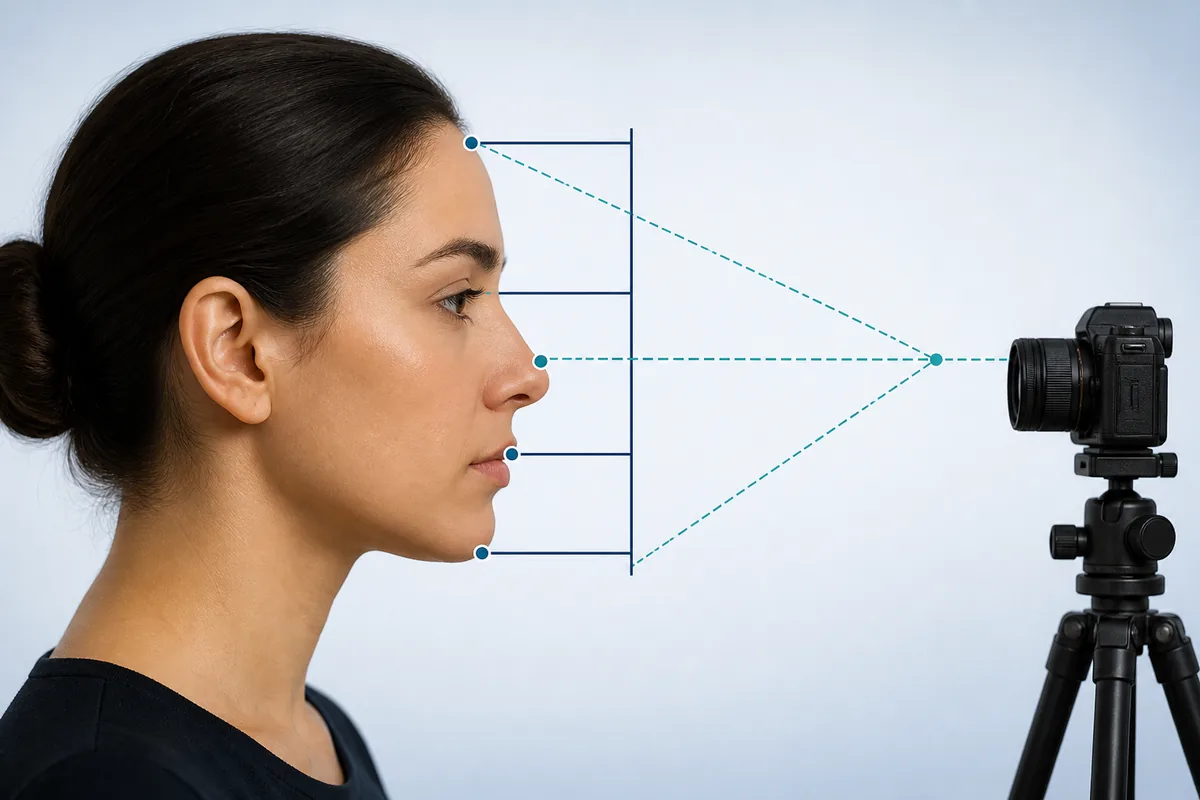
- Use a camera with a normal or portrait-like field of view. Step several feet away and zoom slightly instead of holding a wide-angle phone close to the face.
- Place the camera near eye level and keep it perpendicular to the side of the head. A tripod or stable surface makes repeat photos more consistent.
- Turn to a true 90-degree profile. Keep both eyes level, look straight ahead, relax the lips, and avoid pushing the jaw forward or tucking the chin.
- Use even light and pull hair away from the forehead, cheek, ear, jaw, and neck. Remove filters and portrait effects that reshape the outline.
- Mark the brow or nasal root, nose tip, base of the nose, most forward points of the lips, and the front-most point of the chin. Use the same landmark definitions each time.
- Compare several relationships: nose-to-chin reference line, lip position, facial convexity, nose-lip angle, chin projection, and the vertical balance of the upper, middle, and lower profile.
- Repeat with a second photo taken under the same conditions. If the outline changes substantially, treat the discrepancy as photographic error rather than a facial change.
Pixels are sufficient for ratios within one image. Real millimeters require a calibration object positioned in the same plane as the face, and even then a two-dimensional photo cannot replace a clinical examination or a standardized cephalometric image.
Golden Ratio, E-Line, Angles, and Profile Relationships
Popular profile guides often mix several different systems. Keeping them separate prevents a single measurement from being treated as a complete evaluation.
| Relationship | What it describes | Main limitation |
|---|---|---|
| Golden-ratio comparisons | Relative distances or segments compared with Phi or another preferred proportion. | There is no single validated 1.618 profile template for every person. |
| E-line | Approximate lip position relative to a line from the nose tip to the chin. | Changes with nose size, chin projection, age, dental support, and landmark choice. |
| Nasolabial angle | The relationship between the underside of the nose and the upper lip. | Sensitive to head position, lip posture, nose shape, and measurement method. |
| Facial convexity | How straight or curved the soft-tissue profile appears from upper face to chin. | A photo cannot reveal which dental, skeletal, or soft-tissue factor creates it. |
| Jaw-neck angle | The transition from lower jaw and chin into the neck. | Strongly affected by posture, body position, focal length, and soft tissue. |
These relationships describe different parts of the same profile. None can account for facial width, movement, skin and soft-tissue quality, dental function, cultural preferences, or how the face looks in three dimensions.
Why a Perfect Side Profile Ratio Can Be Misleading
Profile proportions change with camera distance, lens choice, head rotation, posture, expression, and lighting. Moving the camera closer enlarges the nose relative to the ear and jaw. Raising the chin sharpens the jaw-neck angle and moves the lips and chin relative to reference lines. A partly rotated face can make the nose or chin projection look different from a true side view.
Interpretation also depends on normal human variation. Age changes lip support and soft tissue. Dental position affects the lips. Nose and chin growth do not follow identical timelines. Ancestry and individual skeletal pattern influence average measurements, while personal and cultural preferences affect what observers call harmonious. This makes one social-media template a poor standard for everyone.
- Do not compare a close selfie with a distant portrait and assume the face changed.
- Do not convert an entertainment ratio into a medical, orthodontic, or surgical diagnosis.
- Do not judge a profile from one frozen expression or one side only.
- Do not treat minor departures from a reference line as flaws that require correction.
- Use the same capture method when tracking styling, posture, or treatment-related changes.
When a Professional Facial Profile Assessment Is Useful
An educational photo review can help you ask better questions, but it cannot determine bite relationships, airway issues, jaw growth, nasal function, or treatment suitability. An orthodontist can assess teeth and jaw relationships; an appropriately qualified medical specialist can evaluate breathing, injury, soft tissue, or surgical concerns. A responsible consultation considers function, three-dimensional anatomy, realistic outcomes, and personal goals rather than chasing a generic ratio.
If your interest is cosmetic only, bring standardized photos and explain the specific relationship that concerns you instead of requesting a target score. Ask how camera simulations differ from expected real-world results, what alternatives exist, and what risks or tradeoffs apply. No online profile calculator can answer those questions for an individual face.
Golden Ratio Side Profile FAQ
References and measurement context
- A peer-reviewed review in the National Library of Medicine discusses facial attractiveness research and the limits of applying the golden ratio as a universal rule. NCBI: facial attractiveness and proportions
- The American Association of Orthodontists explains that orthodontic evaluation considers teeth, jaws, facial profile, growth, and function together. AAO: orthodontic evaluation
- The American Society of Plastic Surgeons provides patient-safety guidance for selecting qualified professionals and understanding procedure risks. ASPS patient safety