Rate My Face AI: How AI Face Raters Work
A practical guide to photo-based face scores, the measurements behind them, and the limits that matter.


A face-rater score is an interpretation of one image, not a permanent measure of a person.
In this guide
What does a rate my face AI score mean?
A rate my face AI result is a model output tied to one photograph. The system first finds a face and visible landmarks, then compares measurements or visual patterns with the examples used during development. Depending on the product, the final number may summarize facial symmetry, vertical thirds, width-to-height ratios, feature spacing, jaw and chin contours, or general photo quality. Some services use a fixed formula; others use a learned model that is harder to explain. The same person can receive a different result when the input image changes.
Treat the score as feedback about an image and a chosen measurement system. A high number does not prove that someone is more attractive, healthy, trustworthy, or likely to succeed. A low number does not identify a flaw that needs fixing. Cultural preferences, age, expression, grooming, styling, camera processing, and the dataset behind a model all influence what it recognizes. The useful question is not whether a score is a final verdict, but which visible factors moved it and whether those factors matter for the photo you want to use.
A better mental model
Read a face rating as a repeatable opinion about one image under one rubric. Compare similar photos, inspect the component metrics, and keep the result separate from self-worth.
| Output | What it can describe | What it cannot prove |
|---|---|---|
| Overall score | A weighted summary under the service's rubric | An objective ranking of human value |
| Symmetry | Visible left-right differences in the image | Perfect biological symmetry or health |
| Proportions | Ratios such as face height, width, or facial thirds | One universal ideal for every face |
| Percentile or tier | How the score compares with a reference set | A representative sample of every culture |
| Written feedback | Patterns the model detected in the photo | A professional diagnosis or personal assessment |
How AI face rating works
Most face-rating systems follow a pipeline rather than a single magic calculation. The first stage detects a face and rejects or crops images that do not meet its requirements. The next stage aligns landmarks such as eye corners, nose points, mouth edges, cheek contours, and jaw boundaries. A geometry-based service can calculate ratios from those points. A learned model may convert the aligned image into features and estimate a score from patterns found in its training data. The product then formats the output as a number, a tier, a percentile, or a written explanation.
Use these steps to make a rating easier to interpret:
- Check the input: Use one clear, unfiltered portrait with the full face visible and no competing faces.
- Identify the rubric: Look for the metrics, reference group, scale, and whether the tool uses a formula or a learned model.
- Read components first: See whether lighting, angle, symmetry, proportions, or a single feature explains the headline number.
- Repeat fairly: Compare photos taken with similar distance, lighting, expression, and camera settings.
- Decide what to do: Use actionable photo feedback for a portrait choice, and ignore claims that demand a personal or medical conclusion.
Why the same face gets different ratings
When people say a face rater is inaccurate, the image is often changing more than they realize. A wide-angle selfie taken close to the camera exaggerates the center of the face. Side lighting creates shadows that can make one cheek, eye, or jaw look more prominent. A tilted head changes vertical measurements. Smiles, squints, heavy makeup, glasses, filters, and facial hair can also hide or redraw landmarks. These effects do not mean that your face changed; they mean that the model received different evidence.
For a cleaner comparison, use a neutral expression, soft light from in front of you, a camera at eye level, and enough distance to avoid a wide-angle stretch. Keep the image sharp and use the same crop for each test. If a service accepts a profile image, do not compare a front-facing result with a side-profile result as if they measured the same thing. A rating that moves dramatically after a small photo change should be treated as photo sensitivity, not as a new truth about you.
| Factor | Typical effect | Better comparison |
|---|---|---|
| Distance and lens | Close wide-angle shots stretch central features | Use a normal lens and step back |
| Lighting | Hard shadows hide or exaggerate contours | Use soft, even front light |
| Head angle | Tilt changes vertical and symmetry landmarks | Keep the camera and face level |
| Expression | Smiles and squints change eye and mouth cues | Use a relaxed expression |
| Filters and edits | Smoothing or reshaping changes the evidence | Use an unfiltered original |
| Crop and resolution | A small or blurry face gives fewer landmarks | Use a sharp, centered portrait |
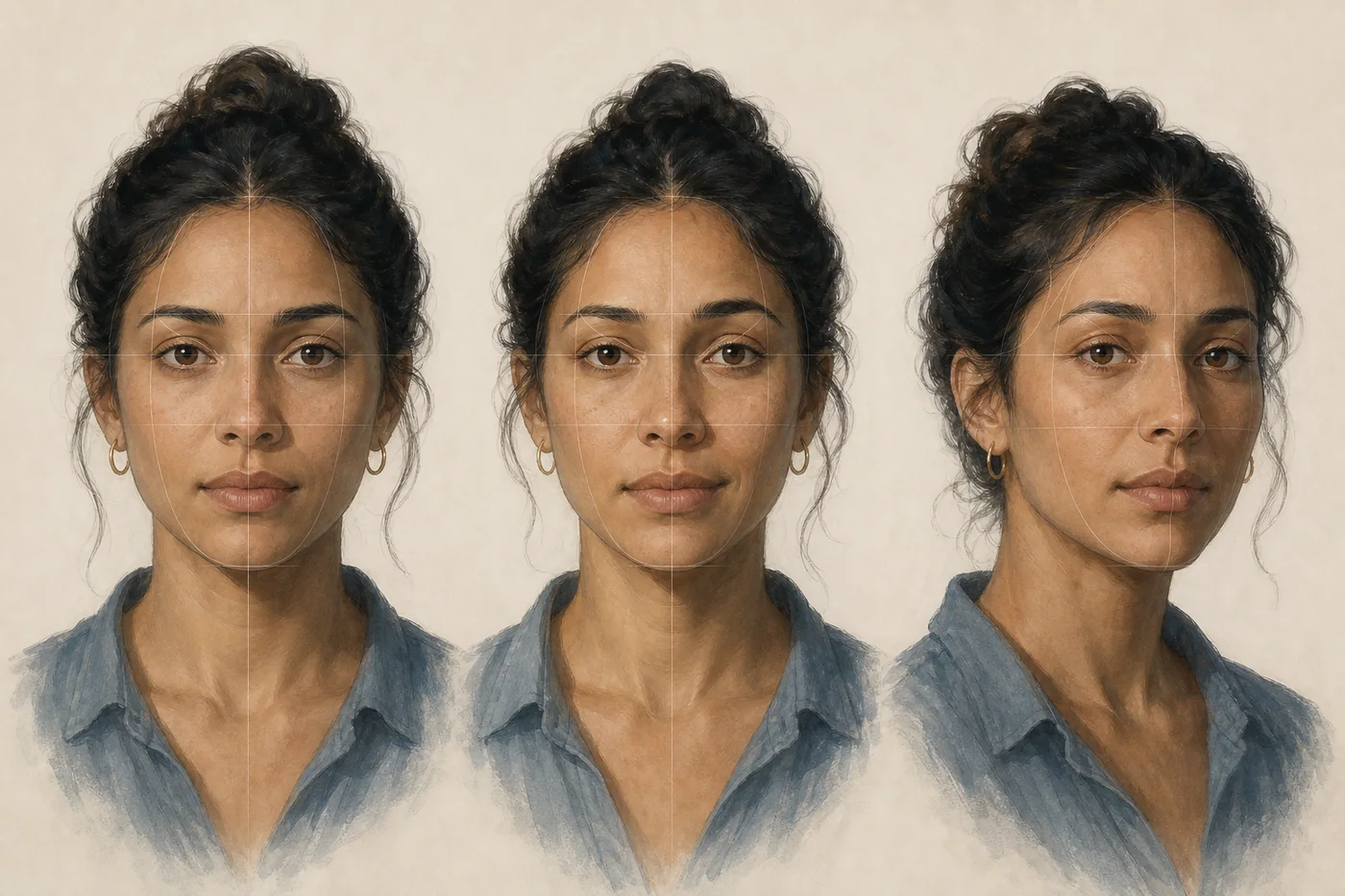
How to read a face-rating breakdown
A breakdown is more useful than a headline number because it shows what the service is actually measuring. Start by checking the scale and direction: does a larger value mean more symmetry, closer proportions, or simply a higher model confidence? Then check whether the components are independent. A tool that lists symmetry, golden-ratio alignment, facial thirds, and jawline may be reusing related landmarks, so adding the numbers does not create four separate facts. Ask what the image supports before assigning meaning to a label such as “balanced” or “photogenic.”
If the service gives a percentile, read the reference group and date if they are available. Percentiles depend on who is in the comparison set and how the set was collected. Treat a tier as a communication device rather than a scientific category. The strongest practical signal is a consistent change across similar images, such as a level camera repeatedly improving the same composition metric.
- Look for the measurement definition, not just a flattering label.
- Check whether the model reports uncertainty, a range, or only a single precise-looking number.
- Separate image composition advice from claims about personality, health, age, or dating outcomes.
- Save the input conditions when comparing photos so you know what actually changed.
- Use proportion tools for proportion questions and a human reviewer for goals that require context.
Privacy and safer use of face-rater tools
A face photo is personal data even when a service calls the result entertainment. Before uploading, read the privacy policy for storage duration, model training, third-party processors, account requirements, deletion controls, and whether the image leaves your device. HTTPS protects the connection in transit, but it does not tell you what happens after the upload. A clear service should explain those choices in plain language rather than promising “secure” without details.
Use your own photo, avoid identity documents and images of children, and do not upload another person without permission. Do not use a public face rater for hiring, school admission, insurance, law enforcement, age verification, or any decision that affects access or rights. If you are uncomfortable with retention, choose a browser-only measurement tool or keep the analysis offline. Delete downloaded reports and shared score cards when they are no longer needed.
- Confirm who operates the service and how to contact them.
- Check whether photos are stored, used for training, or shared with vendors.
- Prefer the minimum upload and avoid linking a face to your full name or identity documents.
- Treat an AI score as non-sensitive entertainment only when the surrounding use is genuinely low risk.
- Stop using a service that pressures you to pay, share, or upload more photos to unlock basic context.
How to choose a useful rate my face AI tool
Choose a tool according to the question you actually want answered. For a quick sense of how a portrait reads, look for clear input guidance, a visible breakdown, and a way to compare images under the same conditions. For facial thirds, symmetry, or golden-ratio measurements, a focused calculator is easier to audit than one attractiveness score. A trusted human reviewer can explain expression and styling context that a model cannot see.
Be cautious with services that promise scientific accuracy without describing a dataset, scale, or limitation. A polished score card is not evidence of validation. Prefer products that show what was measured, explain uncertainty, state image restrictions, and make deletion understandable. Do not let a high score encourage risky disclosure or a low score push you toward unnecessary cosmetic decisions. The best result is a clearer photo choice and a better understanding of the measurement.
Pair this guide with a focused measurement when that matches your goal. The Golden Ratio Face Calculator covers broad proportions, while the Face Symmetry Test and Facial Harmony Calculator keep outputs tied to named measurements.
Use the narrowest useful question
Ask for symmetry when you need symmetry, facial thirds when you need vertical balance, and photo feedback when you need composition advice. Narrow questions produce results that are easier to check.
Frequently Asked Questions
References and Further Reading
- NIST explains how face-analysis evaluations are designed and why performance should be read with context. Face Recognition Technology Evaluation
- The ICO provides guidance on handling biometric and special-category data responsibly. Biometric data guidance
Last updated: October 24, 2026