Face Symmetry Test Explained: What Facial Symmetry Really Means
A practical guide to checking left-right balance in a photo without treating one image, score, or ratio as a definition of beauty.


What Does a Face Symmetry Test Measure?
A face symmetry test is a photo-based comparison of left and right facial landmarks. Depending on the tool or manual method, it may compare the height of the brows and eyes, the position of the nose, the level of the mouth corners, cheek width, jaw contour, and the relationship of the chin to the center of the face. The result is usually a visual balance estimate rather than a clinical measurement.
The phrase facial symmetry sounds exact, but faces are three-dimensional and constantly moving. A small head turn can make one cheek look wider; a close phone lens can enlarge the center of the face; a smile can lift one side of the mouth. That is why a useful test describes the photo conditions and the visible pattern instead of promising a permanent score.
The best question is not “Am I perfectly symmetrical?” It is “Which landmarks look different in this image, how repeatable is that difference, and does it matter for the task I care about?” That mindset keeps a symmetry check informative rather than judgmental.
Relative, not absolute
The comparison is relative to the selected photo and landmarks. It is not a universal measurement of beauty.
Photo-dependent
Angle, lens distance, lighting, expression, hair, and image cropping can move the apparent centerline.
One feature is not the whole face
A slightly uneven brow or jaw does not automatically mean the entire face is visibly unbalanced.
The Landmarks Behind a Facial Symmetry Check
A clear explanation separates the landmarks being compared from the score used to summarize them. These are common visual reference areas; different tools may use different landmark models and tolerances.
| Area | What is compared | Why the result can vary |
|---|---|---|
| Eyes and brows | Eye-line height, brow position, and spacing from the centerline | Expression, eyelid position, and a tilted camera can make one side appear higher |
| Nose and midline | The visible nose bridge and tip relative to the face center | A slight head turn changes the apparent center and shadow pattern |
| Mouth | Corner height, lip line, and distance from the center | Speech, smiling, tension, and resting expression are not perfectly fixed |
| Cheeks and jaw | Left-right width, contour, and chin alignment | Hair, lighting, facial hair, and lens perspective can hide or exaggerate contour differences |
| Overall balance | How several landmarks agree as a group | A combined score can hide which individual landmark caused the difference |
If a tool reports a percentage or score, treat it as a compact summary of its own model. Look for the explanation of the landmarks and confidence notes before comparing two different tools or two different photos.
How to Take a Better Face Symmetry Test Photo
The quality of the input photo often matters more than a small difference in the final number. For a repeatable check, use a neutral portrait rather than a close selfie taken at arm’s length. Keep the camera near eye level, face the lens directly, and leave enough space around the head so the face is not stretched at the edges.
You do not need a professional camera. You do need consistent conditions. If you compare results over time, repeat the same distance, lighting direction, expression, hairstyle, and image crop as closely as possible.
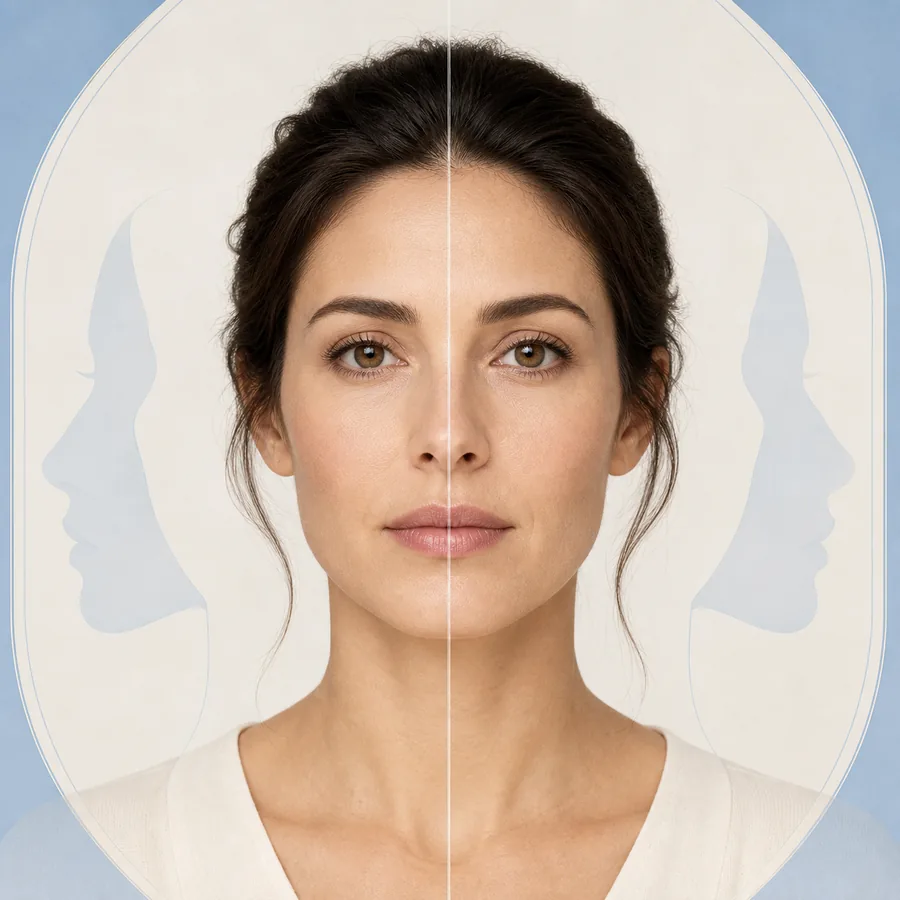
- Use a front-facing photo with the camera at eye level and the head neither tilted nor turned.
- Keep the phone or camera farther away and crop later; very close wide-angle selfies can enlarge the nose and center of the face.
- Use soft, even light from the front. Strong side light can create a false impression of different cheek or jaw width.
- Relax the face and keep the mouth closed without clenching. Avoid comparing a smile with a neutral expression.
- Keep the image clear and uncropped around the hairline, cheeks, jaw, and chin. Repeat the check with a second neutral photo before drawing a strong conclusion.
How to Read Left-Right Differences
A helpful interpretation names the pattern and the confidence level. For example, “the left mouth corner appears slightly higher in this photo” is more useful than “my face is asymmetrical.” It keeps the observation tied to a visible landmark and leaves room for expression, camera position, and normal anatomy.
When a result looks surprising, repeat the photo setup before searching for a correction. If the same pattern appears across several level photos, you can treat it as a more stable visual characteristic. Even then, stable does not mean abnormal, unattractive, or medically important.
| Observed pattern | A careful reading | What to check next |
|---|---|---|
| Small difference in one landmark | Common natural variation or photo noise | Repeat with a level camera and neutral expression |
| Several landmarks shift in the same direction | Could reflect head turn, lighting, or a more consistent facial pattern | Compare another standardized photo and review the centerline |
| A score changes between photos | The tool is responding to different inputs, not measuring a fixed identity number | Keep distance, crop, light, and expression consistent |
| A sudden visible change with symptoms | Not an online beauty-analysis question | Seek qualified medical advice promptly |
| Symmetry looks balanced but harmony feels different | Symmetry and overall facial harmony are related but not identical | Read the proportions and feature-balance context too |
For a direct photo check, you can try the Face Symmetry Test on this site. It is still best used as an educational second opinion: inspect the image, read the notes, and avoid turning the output into a personal verdict.
Limits of Facial Symmetry Scores
Perfect bilateral symmetry is not a realistic requirement. Natural faces contain small differences in bone, soft tissue, muscle use, and expression. A mirrored face can also look unfamiliar because the brain is more accustomed to the original asymmetries than to a mathematically reflected version.
Symmetry is only one part of how a face is perceived. Facial thirds, feature spacing, profile, skin, expression, age, styling, cultural context, and personal preference all influence the impression of balance. A high or low score on one system cannot capture that whole picture.
Avoid using an online face symmetry test to diagnose a condition, decide on treatment, or pressure yourself into cosmetic changes. If your concern is persistent or distressing, a qualified clinician or counselor can provide context that a photo tool cannot.
- Do not compare scores from different apps as if they used the same landmarks, camera correction, or scale.
- Do not treat a mirrored preview as a more truthful version of your face; it is simply a different visual arrangement.
- Do not use a single low-quality selfie to make conclusions about your jaw, nose, or facial health.
- Use a symmetry result alongside broader proportion and photo-quality notes, not as a standalone beauty ranking.
Face Symmetry Test FAQ
References and Further Reading
- PubMed search results for research on facial symmetry and facial perception. PubMed
- Use the site's photo-based tool for a standardized educational symmetry check. Face Symmetry Test
- Read the related guide for normal facial asymmetry, photo distortion, and warning signs. Facial Asymmetry Guide
Related Guides and Tools
Last updated: August 22, 2026